
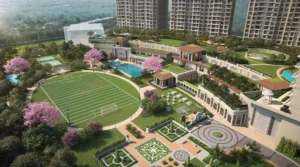
Real estate developers frequently cite open space percentages as a quality indicator, but the number itself is often presented without context. What does it actually feel like to live in a community where 65 percent open space apartment complex daily lifestyle is the norm? How does it change your mornings, your weekends, your children’s play time and your evening walks? This article translates the 65 percent open space ratio at Lodha Sadahalli from an abstract percentage into a concrete daily living experience that you can visualise and evaluate.
Understanding the Open Space Ratio — The Mathematics of Space
The open space ratio luxury apartments Bangalore is calculated by dividing the total area of the development that is not occupied by buildings, roads and parking structures by the total development area. At 65 percent, Lodha Sadahalli dedicates approximately two-thirds of its Phase 1 land area to open landscape — gardens, pathways, water features, sports zones, children’s play areas, pet parks and natural green corridors.
To appreciate what this means, consider the contrast with typical Bangalore luxury projects. Most premium developments achieve open space ratios of 35 to 50 percent — respectable by industry standards but fundamentally different in the lived experience they create. At 35 percent open space, buildings dominate the landscape and green areas feel like decorative inserts between concrete structures. At 50 percent, the balance shifts toward a more pleasant environment but with visible density in common areas. At 65 percent, the relationship reverses entirely — landscape dominates and buildings feel like carefully placed elements within a garden rather than dominant structures with gardens added as afterthoughts.
Green Cover Benefits for Residential Projects
The green cover benefits residential projects deliver extend well beyond aesthetic appeal into measurable health and wellbeing outcomes.
Air quality within a 65 percent open space community is meaningfully better than in surrounding urban areas. Trees and plantings act as natural air filters, absorbing particulate matter, carbon dioxide and other pollutants while releasing oxygen. In a city like Bangalore — where air quality has deteriorated significantly in recent periods due to construction activity, vehicle emissions and urban heat island effects — living within a densely landscaped green environment provides a literal breath of fresh air every day.
Temperature regulation is another tangible benefit. Urban areas experience a well-documented heat island effect where concrete and asphalt absorb and radiate heat, elevating ambient temperatures by several degrees above surrounding green zones. A community with 65 percent green cover creates its own micro-climate — cooler in summer, more temperate year-round and less dependent on air conditioning for thermal comfort. Over years of residence, this reduced air conditioning dependence translates into measurable energy savings and a more comfortable indoor environment.
Mental health benefits are perhaps the most profound but least quantified advantage of living within abundant green space. Research across multiple countries consistently demonstrates that daily exposure to natural environments reduces stress hormone levels, improves mood, enhances cognitive function and contributes to better sleep quality. For families where both adults work demanding professional roles and children face academic pressures, living in an environment that passively reduces stress through constant nature exposure is a genuine health investment.
Maximum Open Space Apartments in Sadahalli North Bangalore
For buyers specifically seeking maximum open space apartments Sadahalli North Bangalore, Lodha Sadahalli represents the benchmark in the micro-market. The 65 percent ratio is achievable because of the 70-acre township scale and the deliberate design choice to limit Phase 1 to only two towers on 15 acres.
This open space is not concentrated in a single large garden but distributed throughout the community in a variety of forms. The central green spine runs through the heart of the development, connecting the residential towers to the clubhouse and community facilities through a continuous landscaped corridor. Peripheral walking and jogging paths loop around the community boundary, providing extended routes for daily exercise without leaving the gated environment. Dedicated zones — the pet park, the children’s play areas, the senior citizen wellness garden, the yoga and meditation deck — are each set within their own landscaped context, creating multiple distinct outdoor environments within the single community.
This distribution of open space is important because it ensures that every resident — regardless of which tower they live in, which floor they occupy or which direction their apartment faces — has immediate access to green space without traversing the entire community. Step out of your lobby and you are in a garden, not a parking lot.
What 65 Percent Open Space Looks Like on a Typical Day
Imagine waking up and looking out your window across a landscape that is predominantly green — tree canopies, manicured lawns, flowering shrubs and the occasional water feature catching morning light. You step out for a morning walk on a dedicated path that winds through landscaped gardens, separated from any vehicular movement. Your children walk to the play area through green corridors rather than across parking lots. Your parents sit in a shaded senior zone, enjoying quiet conversation amid birdsong rather than traffic noise.
In the evening, you swim in a temperature-controlled pool set within a landscaped clubhouse precinct. Your dog explores the dedicated pet park under supervision while you chat with neighbours on a garden bench. After dinner, you take a stroll along the peripheral walking track, completing a loop that takes twenty minutes through a variety of landscape settings — formal gardens, natural woodland, water features and open lawns.
This is not an aspirational description. It is the daily reality that a 65 percent open space ratio enables when the landscape is designed with intention and maintained with commitment. For a deeper understanding of how the broader master plan creates this environment, and how the multi-level clubhouse integrates with the outdoor landscape, explore our dedicated guides.
Open Space and Property Value
The relationship between open space and property value is well-established in real estate markets globally. Properties within communities with above-average green cover command rental and resale premiums that reflect the superior living environment. These premiums are resilient during market downturns because the living quality that abundant green space provides is not replicated by competing projects that lack the land to achieve comparable ratios.
At Lodha Sadahalli, the 65 percent open space ratio — combined with the low-density two-tower design — creates a living environment that structurally cannot be replicated by competitors in the same micro-market. This supply-side uniqueness supports premium pricing and sustained appreciation over the ownership horizon.
To experience the open space environment at Lodha Sadahalli, schedule a site visit. Visit the amenities page for lifestyle details.